A lot of the students who walk into our classrooms tell us the same story. They wanted to work in healthcare, but they couldn’t take four years off for school, and they couldn’t take on the debt either. Then somebody mentioned phlebotomy.
Phlebotomists are the people who draw blood for lab tests, transfusions, and donations. Just about every hospital, lab, and clinic in the country needs them. The Bureau of Labor Statistics expects the field to grow 6% between 2024 and 2034, which is faster than average, and figures there will be around 18,400 openings a year. And unlike most healthcare jobs, the training itself can be done in days — our accelerated course runs two or three days, depending on the format you pick.
Here’s how the whole process works, start to finish.
Step 1: Meet the Basic Requirements
The list is short. Most training programs and employers want you to:
- Be at least 18
- Have a high school diploma or GED
- Pass a background check (many clinical employers will also ask for a drug screening)
- Have certain immunizations, which hospitals and clinical sites usually require
Notice what’s not on that list: a college degree, healthcare experience, science classes. None of it is required. We’ve taught 19-year-olds fresh out of high school and people in their fifties starting a second career, and both do just fine.
Step 2: Complete a Phlebotomy Training Program
A few employers still train people on the job, but honestly, those postings are getting rare. Most want someone who’s already been trained. A good course will teach you:
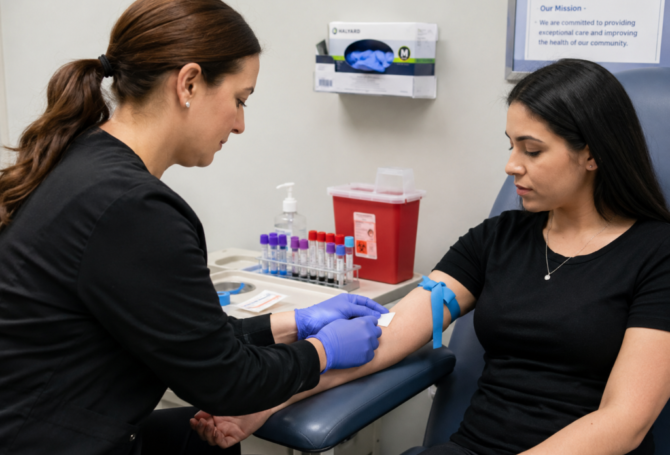
- Venipuncture — finding a vein and drawing blood safely, without hurting anyone
- Capillary (fingerstick) collection
- Order of draw, tube types, and how to handle specimens
- Infection control and OSHA safety rules
- How to work with patients, including the nervous ones (there are a lot of nervous ones)
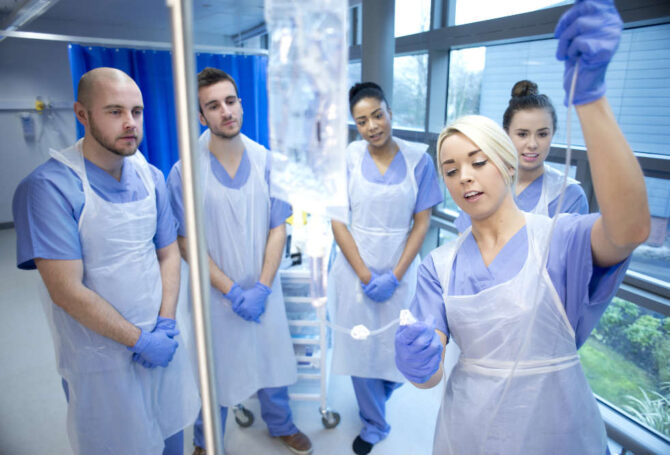
One piece of advice if you’re comparing schools: ask how much time you’ll actually spend with a needle in your hand. Watching videos about blood draws doesn’t make you a phlebotomist. Practicing does. That’s why we built our course the way we did at Northwest Phlebotomy School: it’s an accelerated two-day weekend or three-day weekday format, and every single day is half lecture, half hands-on lab. You start on simulation arms the first day and move to live draws under instructor supervision after that. Classes stay small — usually 10 to 15 students — so there’s always an instructor close enough to fix your angle before a bad habit sets in. And with 50+ locations, most students find a class date that doesn’t collide with their work schedule.
Step 3: Check Your State’s Rules
In most of the country, there’s no state license for phlebotomy. You finish training, get certified, and start applying. Four states do things differently:
- California has its own state certificate (CPT I) that requires 40 hours of classroom time, 40 hours of clinical practice, and a documented number of successful draws.
- Washington credentials phlebotomists through the Department of Health as Medical Assistant-Phlebotomists (MA-P). It’s a registration step after your training, not a separate degree — a good school will walk you through the paperwork.
- Nevada treats phlebotomists as lab assistants working under a laboratory’s license.
- Louisiana requires a clinical laboratory personnel license from the State Board of Medical Examiners.
If you live in one of those four, build the extra paperwork into your timeline. Everywhere else, training plus a national certification is the standard path.
Step 4: Earn Your National Certification
No federal law says you have to be certified. But try telling that to hiring managers — most of them either require certification or quietly set uncertified resumes aside. The exams that carry weight come from the National Healthcareer Association (NHA), the American Society for Clinical Pathology (ASCP), American Medical Technologists (AMT), and the National Center for Competency Testing (NCCT).
A school that knows what it’s doing will prepare you for the exam as part of the course, so you can test soon after you finish instead of studying alone for months. [See our guide to the national phlebotomy certification exam] if you want to know what test day looks like.
Step 5: Apply for Your First Job
People assume phlebotomists only work in hospitals. Hospitals are the biggest employer, at about 36% of jobs, but diagnostic labs employ nearly as many (32%), and blood donation centers and outpatient services make up another big chunk. Physicians’ offices hire too. Each setting has its own feel — hospital work is faster-paced, lab draw stations are more routine, donation centers tend to attract people who like the mission
On your resume and in interviews, lead with three things: how many successful draws you did in training, your certification (or your exam date if it’s scheduled), and any customer service experience you have. That last one surprises people, but half this job is putting another human being at ease.
And don’t job-hunt alone if you don’t have to. Career guidance is part of what you’re paying a school for — ours comes with the course, and our support team is around six days a week.
Step 6: Keep Growing
Some of our graduates are still happily drawing blood ten years later. Others used phlebotomy as their way into nursing or lab science — it’s paid healthcare experience, and it looks good on any clinical school application. A common next step either way is adding IV certification, which broadens what you can do and what you can earn. [Learn more about our IV training certification.]
Frequently Asked Questions
How long does it take to become a phlebotomist?
The classroom training can take as little as two or three days in an accelerated course like ours. After class, you take your written certification exam, and a few states add their own paperwork. Most students are ready to apply for jobs within a few weeks of their first day of class. [Here’s the full timeline, step by step.]
Do I need a degree?
No. A high school diploma or GED plus a training course is the normal path. The BLS lists a certificate — not a degree — as the typical entry-level education.
How much do phlebotomists make?
The national median was $43,660 a year, or $20.99 an hour, as of May 2024 (BLS). Experience, location, and shift all move that number — top-paying states like California and Washington average closer to $49,000–$50,000, and night-shift hospital roles typically pay more.
Is phlebotomy hard to learn?
The technique takes practice, and almost everyone is nervous on their first stick. That’s normal. With good hands-on instruction, most students are surprised how quickly it clicks.
Ready to Start?
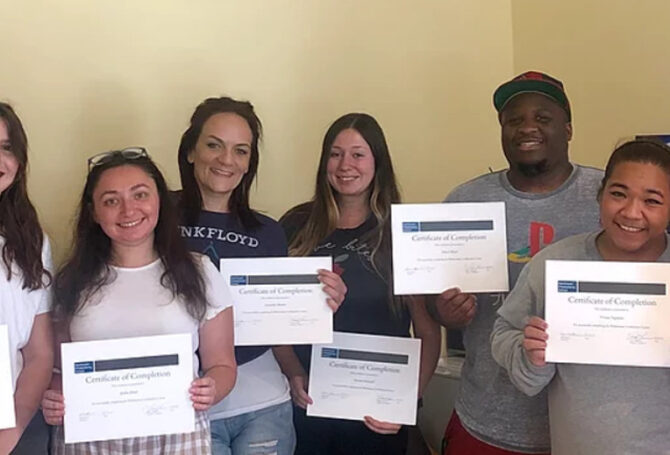
We’ve trained more than 25,000 students, and a lot of them told us later that the hardest part was just signing up. Classes run weekdays, evenings, and weekends at 50+ locations, and you keep access to the classroom materials for life. Find a class near you and get started.